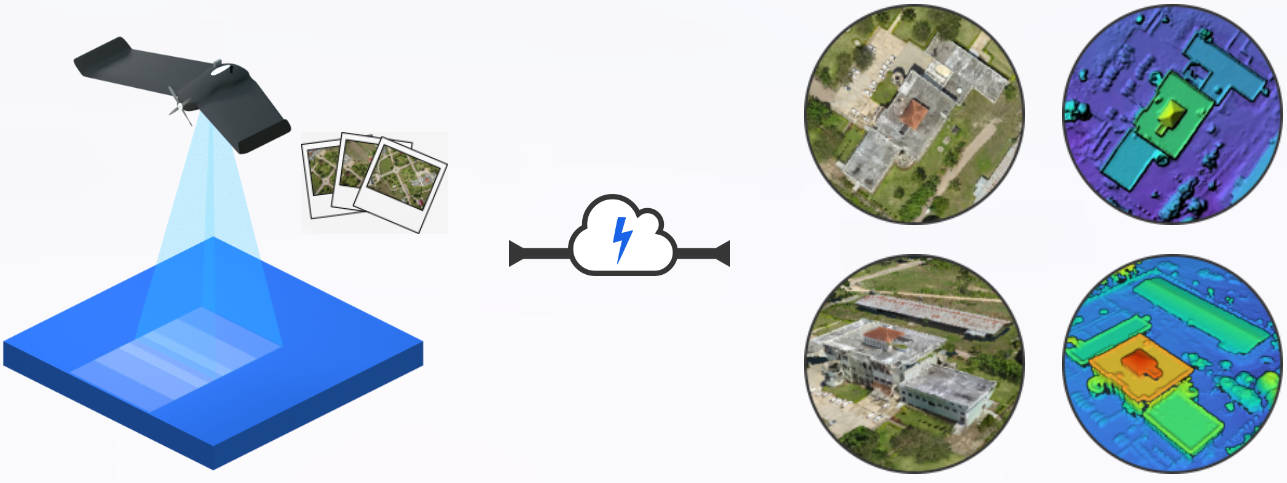

No need to download or install software. Just upload, process, share.

Process up to 3,000 images and get fast results.

Seamlessly share links to maps and models with clients.

Get started for free, without commitment. Then purchase with confidence with a 30-day money-back guarantee.
: According to Kepler's laws of planetary motion, planets move faster when they are closer to the sun. At perihelion, Earth travels about 1 kilometer per second faster than at its farthest point, making the Northern Hemisphere winter the shortest season of the year by about five days.
So, while you’re bundling up in January, Earth is actually making its annual close pass by the Sun.
The Perihelion: When Earth is Closest to the Sun Every year, around early January, an orbital event occurs that seems to defy common logic for those living in the Northern Hemisphere. While many are scraping ice off windshields and bundling up in heavy coats, the Earth is actually reaching its —the point in its orbit where it is physically closest to the Sun. What is Perihelion? earth is closest to the sun
At this point, Earth was roughly (147.1 million km) from the sun, which is about 3 million miles closer than it will be during its farthest point, aphelion, in July. Key Features of Perihelion
7% more intense sunlight at perihelion than it does at its farthest point. Southern Summer: This extra energy primarily affects the Southern Hemisphere, which is tilted toward the Sun in January. However, because that hemisphere is mostly water—which absorbs heat more efficiently than land—the temperature difference is moderated. EarthDate +3 Quick Comparison Table Feature Perihelion (Closest) Aphelion (Farthest) Typical Date Early January Early July Distance (Miles) ~91.4 million ~94.5 million Orbital Speed ~30.3 km/s (Fastest) ~29.3 km/s (Slowest) Solar Intensity 100% (Baseline) ~93.5% Further Exploration Discover the detailed mathematical breakdown of orbital eccentricity at Science Notes . Read about how the Earth's orbit shifts over thousands of years on EarthSky . Explore why Southern Hemisphere summers are moderated by oceans despite perihelion at NASA's Earth Observatory . Would you like to know the : According to Kepler's laws of planetary motion,
Eventually, the orbit will carry us away. By July, we will drift to the farthest point of our ellipse, wandering into the cool dark of deep space, three million miles further out. And yet, paradoxically, the Northern Hemisphere will be sweltering. We will be farther from the fire, but facing it head-on, absorbing its full force.
Here’s a short, informative text based on your prompt: The Perihelion: When Earth is Closest to the
If we are roughly 3 million miles closer to our solar heat source in January, why is it so cold in the North?
If you were to ask the shivering figure scraping ice off a windshield in the dead of January, or the child bundled in three layers of wool waiting for a school bus in the gray pre-dawn, they would tell you the sun has abandoned them. It hangs low and pale in the sky, a weak, diluted version of its summer self. The days are short, the shadows are long, and the world feels vast, empty, and cold.
Yet, astronomically speaking, this is the moment of greatest intimacy.
This disconnect teaches us the most fundamental truth about our planet: distance is not destiny. The tilt of the Earth’s axis is the true architect of our seasons. Because the Northern Hemisphere is tilted away from the sun during perihelion, the light strikes us at a glancing angle, spreading thin over the surface. We are closer to the fire, but we have turned our back to it.






 WebODM